
 REQUEST INVITE
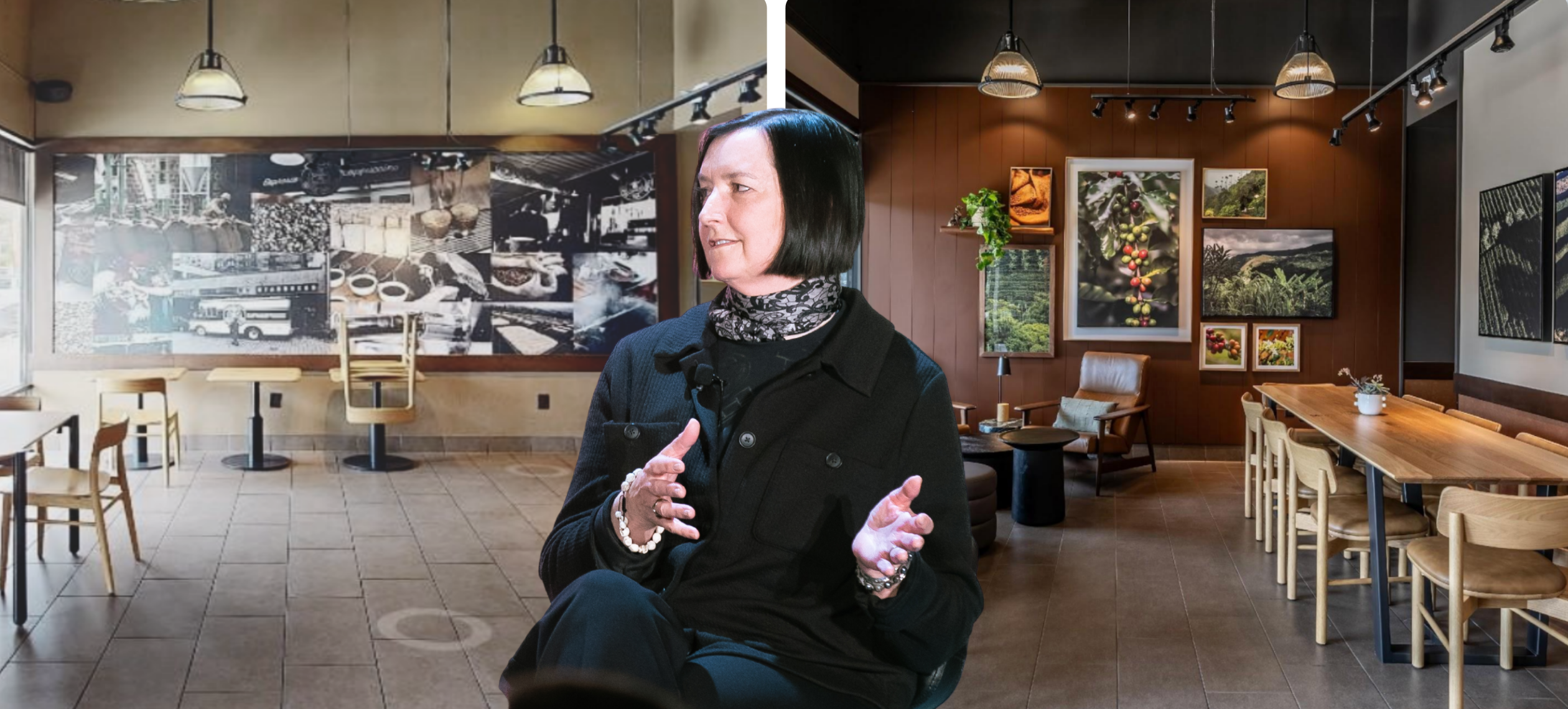
You've stripped out seating to make room for mobile pickup. You've removed menu boards because everyone orders on their phone anyway. You've optimized every square foot for throughput. Your stores are humming with efficiency.
And then you look around and realize you've built something customers rush to leave.
That tension is what Dawn Clark, SVP of Global Concepts & Store Design at Starbucks, unpacked during an exclusive fireside chat at RestaurantSpaces with executive producer Michael P. Owens. Not with corporate spin or carefully hedged language, but with the kind of candor that made attendees lean forward in their seats.
"We just pinned a lot of things up on the wall and looked at them," she said. "What's missing? It was place, not space."
Now she's leading one of the most ambitious redesign programs in retail history: transforming every single Starbucks location back into what made the brand iconic in the first place. Not a coffee shop. A community coffee house.
Clark is uniquely positioned for this mission. She's a "boomerang" employee who worked at Starbucks from 2010-2012 building international design studios across 60 countries, then left for Nordstrom and Amazon. During those years away, she watched as a customer while mobile ordering fundamentally transformed the Starbucks experience—for better and worse.
When Efficiency Killed the Vibe
Clark didn't mince words about what went wrong. The culprit? A perfect storm of incremental changes that, over time, stripped away the very essence of the Starbucks experience.
The launch of mobile ordering in 2016-2017 was a watershed moment. What started as a convenience feature fundamentally changed customer behavior and, consequently, store design. Seating disappeared to make room for mobile pickup zones. The pandemic accelerated this shift, removing even more seats for social distancing.
Before anyone realized it, Starbucks had become efficient at transactions but had lost its soul as a gathering place.
Research That Challenged Assumptions
Here's where it gets interesting for those managing multi-unit portfolios: Clark's team discovered something that runs counter to what many assume about younger consumers.
"There were a lot of assumptions about Gen Z wanting more digital experience," Clark shared. "What we found was actually counter to that. Especially for digital natives, there was more of a desire to have human connection and analog experience."
This insight became foundational to the Back to Starbucks strategy. The technology stays—mobile ordering represents 30% of transactions and isn't going anywhere, but it's now designed to be invisible, supporting rather than dominating the experience.
Small Changes, Immediate Impact
One of the most operationally brilliant aspects of the program is the execution model. These aren't months-long renovations requiring store closures. They're overnight "light uplift" transformations that allow Clark's team to measure immediate before-and-after results without rebuilding the business from scratch.
The changes might seem modest on paper, adding just eight seats in some locations, but the impact tells a different story. "The day we put those seats in the store, every one was taken," Clark noted. "I saw a mother with her daughter taking a break, a woman working on a laptop, a gentleman in a wheelchair, a woman with a stroller."
Measuring What Actually Matters
For design and development leaders, Clark's approach to measurement offers a refreshing perspective. "If you're only managing or looking at sales and measuring sales, you're probably gonna miss the point," she said.
Instead, the team tracks both qualitative and quantitative metrics:
- Dwell time (do people stay longer?)
- Variety of use cases (meetings, dates, solo work)
- Customer mix and inclusivity
- The intangible sense of community connection
The underlying belief is simple: when people want to stay, they build stronger relationships with the brand.
The "Ristretto" Mindset
Clark introduced a concept she calls "ristretto" (Italian for restraint). Just like the espresso shot that delivers full flavor with less water, the new store designs eliminate wasted space while enriching the experience.
This included a complete reimagining of the operational flow. The team streamlined equipment placement, optimized barista choreography (her word), and introduced order sequencing technology to hit a four-minute fulfillment target, a metric that didn't even exist before.
The result is a spectrum of store formats that can flex from very small footprints to larger locations, all delivering the full coffee house experience.
Localization at Scale
When Owens asked Clark about her biggest challenge, she didn't hesitate: "How do you create a system that you can run at the scale and speed that we're running at, but still individualize each store?"
Her solution involves building a design system with enough diversity and flexibility that designers can assemble the right store for each community. But there's always "that one extra thing". Local art, specific accessories, understanding the neighborhood's character. That requires boots on the ground.
"People see themselves in those details," Clark explained. "And that's where they want to hang out."
From Pickup-Only to Community Hub
Perhaps the most telling example is Starbucks' decision to convert pickup-only locations back into full coffee houses. The first conversion added seats, a POS for walk-up ordering, food displays, and crucially removed the "pickup only" signs.
This wasn't about abandoning convenience customers. It was about saying "yes to all" rather than forcing separation. "On any given day you might come in as a mobile order customer and decide to stay because you see a great seat and you have a minute," Clark noted.
Pushing Back on Digital Overload
Clark was refreshingly candid about technology's role in physical spaces. While Starbucks is installing digital menu boards and order status screens, she's constantly asking: "At what point do you have too much digital experience in a physical experience?"
Her concern isn't just aesthetic—it's about preserving dimensionality. "This dimensional sensorial space matters to humans," she emphasized. "For our brand, it is as much about human connection as it is about the product offering."
When asked what design trend drives her crazy, her answer was immediate: "Too many screens. Flattening of experience." She advocates for thinking more toward hospitality than retail or transaction.
Early Results, Clear Direction
With a sizable number of stores completed between New York and Los Angeles, early measurement results are "very, very positive." More importantly, the energy in these spaces feels different.
For leaders managing large-scale retail or restaurant portfolios, the Back to Starbucks strategy offers several key takeaways:
- Don't let efficiency kill experience. Operational improvements that sacrifice the core brand promise are short-term wins with long-term consequences.
- Question assumptions about digital natives. The desire for authentic, analog experiences may be stronger than you think.
- Measure engagement, not just transactions. Dwell time, use case diversity, and community connection are leading indicators of brand health.
- Build localization into systems, not around them. The tension between scale and personalization is real, but it's also where differentiation lives.
- Make technology invisible. Convenience features should support, not replace, the human experience.
As Clark put it simply: "We still want to welcome people who just happen in, just pop in and want to just come up and talk to someone and order that way."
Sometimes, going back isn’t nostalgia. It’s course correction.
Watch the full talk below 👇

Posted by
Chain Restaurants Reimagined.
The Retreat to Reimagine Restaurant Development, Design + Technology.
Oct 18-20, 2026 | Amelia Island, FL

-1.png)
-May-05-2026-12-48-02-5811-PM.png)



Comments