
 REQUEST INVITE
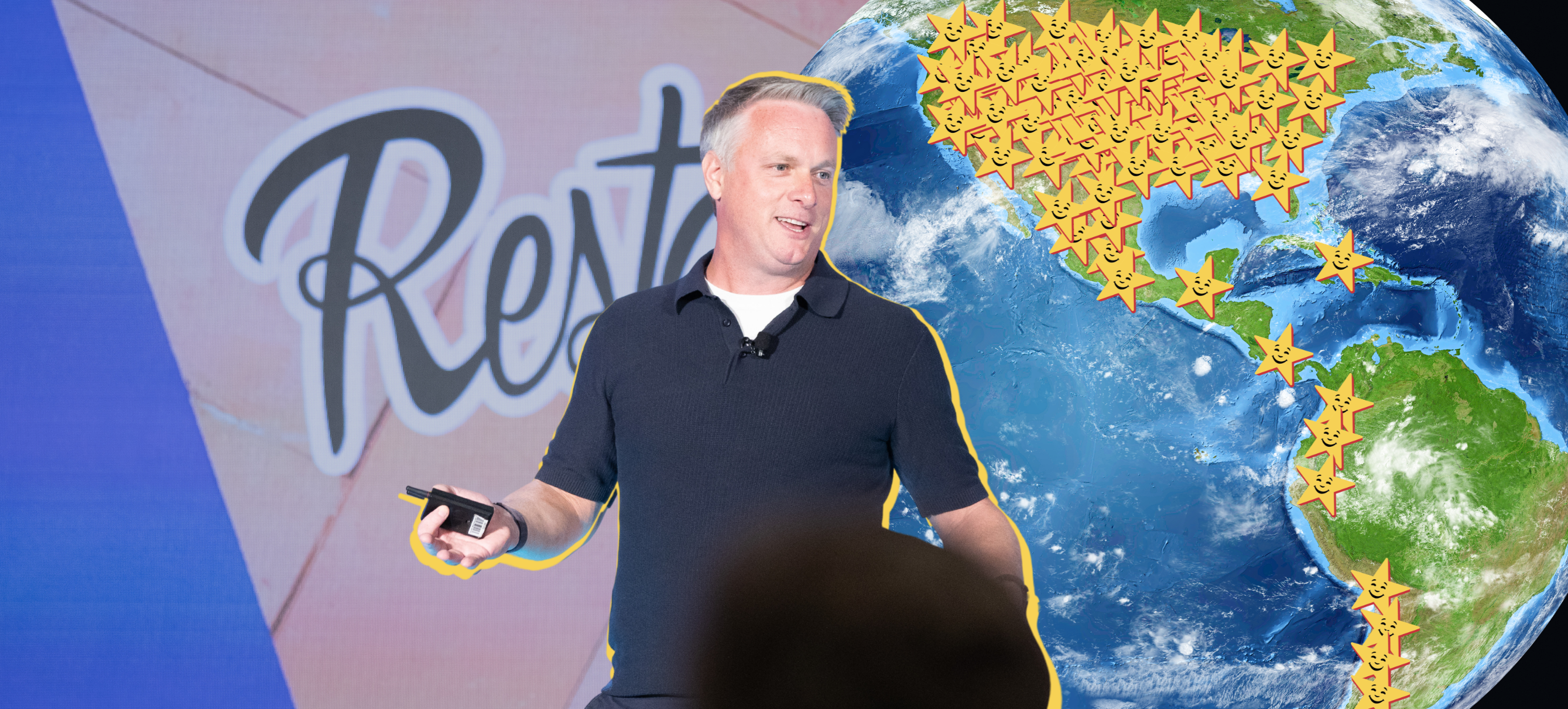
Ewan Davenport has built restaurant brands across Africa, the Middle East, Europe, Latin America, and beyond, first at SABMiller, then at Yum Brands, now as President International at CKE Restaurants, overseeing Carl's Jr. and Hardee's across 1,250 restaurants, 90 franchisees, and 40 countries. At RestaurantSpaces, he did something rare: he led with his failures before his wins. Both turned out to be more useful than any case study about what went right.
The Lesson Started in a Beer Truck
Before leading restaurant brands around the world, Davenport spent eight years in the beer industry. Early in his career, he flew to Nairobi expecting to convince a local brewery to expand an Italian premium beer brand across Africa. Instead of heading into a boardroom, the brewery's managing director handed him a delivery uniform and spent the next seven hours delivering beer across the city.
By the end of the day, Davenport realized the strategy he'd arrived with wasn't going to work. The brand could only succeed if it adapted to the realities of the local market, not by trying to recreate Europe in Africa. It was an early lesson that stayed with him throughout his career: global brands don't scale by treating every market the same.
The $75,000 Container Store That Became a $450,000 Lesson
During his time at Pizza Hut, Davenport faced a real problem: building costs across Africa were high, and consumer spending power was limited. The solution seemed elegant. What if you could fit an entire Pizza Hut inside a shipping container for $75,000 in total cost? Equipment included. His team built it. It worked, technically.
Then reality arrived. Customers didn't want it. The dining environment wasn't what they were coming to Pizza Hut for. The team started expanding the container, adding dining space, improving the experience. By the end, the project had cost four to six times the original budget. "What I didn't realize is how important the whole experience was," Davenport said. "I was trying to create value for our franchisees. It was cost-led, not consumer-led. That was the mistake."
Same Brand, Half a Mile Apart, Nothing in Common
In Rosarito, Mexico, CKE operates two Carl's Jr. restaurants roughly half a mile apart. They share a brand, a menu, and almost nothing else.
The first is a warm, family-oriented restaurant with a large kids' play area, traditional decor, and peak traffic running from lunch through early evening. It does around $3 million AUV. The second sits in a trade area with several universities nearby. The design is darker, more urban, more youthful. It sells beer. Sports play on screens. It also does around $3 to $3.5 million AUV. Cannibalization between the two? Minimal, because they're not serving the same customer.
For Davenport, this is the direct application of his first design principle: design for consumer behavior, not brand uniformity. The brand can hold across both locations without the design having to. Forcing a single format onto both sites would mean one of them underperforms indefinitely.
Be Brave Enough to Be Locally Different
CKE's restaurant in San Cristobal, Mexico sits in a heritage area with significant indigenous communities. Rather than applying a standard interior, they worked with local designers and artists to create murals that reference the spiritual imagery of the region. In Oaxaca, they brought in a local artist to create a design built around the traditional Catrina skeleton figure, then wove in a burger and their shakes as subtle brand elements. That restaurant has been open for three months and is currently tracking $5.5 million AUV.
The same willingness to flex showed up at Pizza Hut's Dubai Mall location, directly facing the Burj Khalifa. Davenport described significant internal pushback when the team proposed brick-oven pizzas and mocktails, products outside the standard Pizza Hut offer. His response: the customer base in that part of Dubai wants those things. "We were willing to go through adaptations in order to make sure we were capturing every consumer." The restaurant became one of the highest-performing in the region.
Modular Builds: The Next Version of Flexibility
CKE is now experimenting with modular construction for Carl's Jr. in Mexico. Instead of treating restaurant size as a permanent decision, the company is designing restaurants that let franchisees start smaller and expand later. If a market is heavily off-premise, they can open with fewer dining modules. If demand grows, they simply add more.
The restaurants are built in sections at a factory, shipped to the site, and assembled on location. The result is a building that looks and operates like a traditional Carl's Jr., but can be constructed faster, expanded more easily, and eventually at a lower cost as more locations adopt the system.
Davenport is candid that the concept is still evolving, but he believes the idea goes beyond construction efficiency. "A design system that's consumer-adaptive but construction-rigid will always have a ceiling on how fast and how broadly it can be deployed." If restaurants are going to adapt to different markets, he argues, the way they're built has to be just as flexible as the way they're designed.
The Bottom Line
Somewhere between delivering beer in Nairobi and building Carl's Jr. restaurants around the world, Davenport learned the same lesson: Brands are very good at talking to themselves. They become fluent in their own standards, their own visual language, their own version of what a great restaurant looks like.
Consumers are rarely as immersed in any of that as the teams building for them. The design and construction leaders who close that gap, by starting with behavior instead of brand, by being willing to be locally different, by letting the format follow the market, are the ones building the most profitable restaurants in the system.

Posted by
Chain Restaurants Reimagined.
The Retreat to Reimagine Restaurant Development, Design + Technology.
April 25-27, 2027 | Huntington Beach, CA

-1.png)
-May-05-2026-12-48-02-5811-PM.png)



Comments