
 REQUEST INVITE
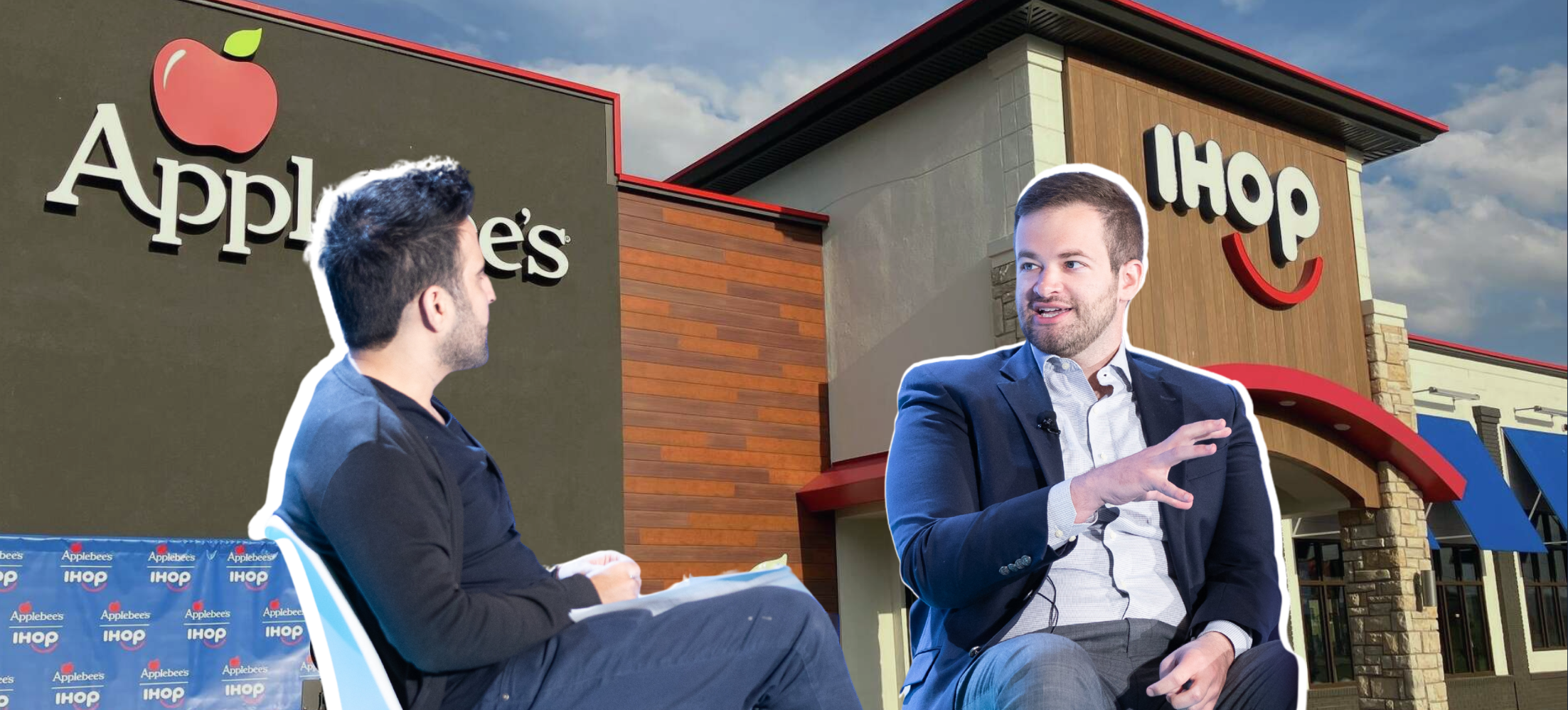
On paper, putting IHOP and Applebee’s under one roof sounds simple. Breakfast from one brand. Lunch, dinner, and drinks from the other. One building that stays busy all day.
Actually making it work? That took a dedicated Dine Brands team six months of rethinking everything from the kitchen and menu to staffing, technology, and the guest experience. At RestaurantSpaces, Jake Nebergall, VP of Strategy and Innovation at Dine Brands, sat down with Zia Durrani, Producer at RestaurantSpaces, to unpack how the company built its dual-brand concept, and why it could open up an entirely new set of possibilities for restaurant real estate.
An Opportunity Hiding in Plain Sight
The origin of the dual-brand concept was not a corporate strategy session. An Applebee's franchisee in Detroit operated his restaurant inside a hotel and kept watching guests leave every morning to eat breakfast somewhere else. He already had the space. Dine Brands already owned IHOP. He asked if he could add one inside the other.
The international team picked it up, tested it in Canada, Mexico, and the Middle East, and by the time roughly a dozen were running successfully overseas, the domestic team could no longer ignore it. They put a dedicated group together for six months to answer one question: what would need to be true for this to scale in the US? The first real test location opened last year. There are now 35 in operation domestically.
The Problem It Actually Solves
Nebergall described the core opportunity plainly: how do you make a space productive all day long? IHOP is a dominant breakfast and morning brand. Applebee's is a lunch and dinner brand with a strong bar business. Combined, the demand curve across the day flattens out. Instead of a restaurant that peaks at one or two day parts and sits quiet the rest of the time, you get a location that drives traffic from opening through last call.
The numbers back it up. Dual-brand locations are currently running between 1.5X and 2.5X the sales of a comparable standalone. On average, about double.
Three Non-Negotiables
Nebergall was specific about the operational requirements the team set before committing to a build. All three had to work, or the economics would not hold.
First: fully cross-trained staff. Front of house needed to sell both menus. Back of house needed to cook both.
Second: one integrated kitchen. Not two parallel lines, not two separate operations sharing a wall. One line running both brands.
Third: seamless guest-facing technology. One POS system. One receipt. One online ordering portal. If a guest had to interact separately with each brand to complete a single visit, the experience falls apart.
Unlocking New Real Estate
Nebergall identified three specific real estate situations where the dual-brand format creates opportunities that neither brand could access alone.
Hyper-urban locations: where a single brand's volume would not justify the rent, but a dual brand generating double the sales might.
Rural markets: where a single brand lacks the AUV to make a new build pencil, but a dual brand does.
Non-traditional venues: airports, travel centers, college campuses, and military bases, where all-day productivity is the entire point of the location.
The other implication: locations currently operating on B-tier real estate could potentially justify A-tier sites with the higher sales that dual branding generates. Roughly half of the 35 existing locations are conversions of existing single-brand restaurants. The other half are new builds. Nebergall expects conversions to remain the primary path, though both will continue.
Why You Can’t Just Add Another Logo
Building a dual brand is close to a million-dollar investment minimum, even if a franchisee already owns one of the locations. That cost exists specifically because both brands need to be fully built out. Early franchisees pushed to just hang the other brand's logo in the window, effectively a co-branded sign with no design investment. Dine Brands refused. Nebergall was clear on why: doing it that way would dilute both brands. The investment is the point.
The dual-brand format is also not a replacement for standalone growth. Dine Brands has no scenario in which duals outnumber singles. It is an additional tool, specifically suited to situations where the conditions that made it work for IHOP and Applebee's align: complementary day parts, the same service model, similar kitchens, and brands of comparable size and recognition.
Fewer Voices, Better Decisions
Nebergall's closing advice for any brand considering a similar move: pull a small team from both sides, take them entirely out of their normal roles, and let them build in isolation. Dine Brands did this literally, locking people in a conference room for six months with minimal contact with their home brands. The reason was not secrecy. It was coherence. Too many opinions, too many voices defending each brand's existing rules, and the concept drifts into something that cannot make a decision. A small team with clear authority and distance from internal politics moves fast and ends up with a single, logical answer.
"Don't listen to everybody," Nebergall said. "Pull a few smart people that know both brands, send them off onto an island, and let them build it."
Watch the full talk below 👇

Posted by
Chain Restaurants Reimagined.
The Retreat to Reimagine Restaurant Development, Design + Technology.
Oct 18-20, 2026 | Amelia Island, FL

-1.png)
-May-05-2026-12-48-02-5811-PM.png)



Comments